54% versus 79%
Globally, office utilisation averages 54%, against an average corporate target of 79%, according to JLL's 2026 report The Flexible Office Space Imperative, as cited by The Realty Today (The Realty Today). That 25-point gap is not only a space-planning problem. People use places that work for them, and avoid places that do not.
What makes a workspace work is not one big decision. It is seven connected ones, and a weakness in any of them leaks into the rest. This piece joins up the threads from our earlier pieces on flex space, fit-outs and community, and adds the layers they leave out.
The seven layers at a glance
| Layer | The question it answers | One piece of evidence |
|---|
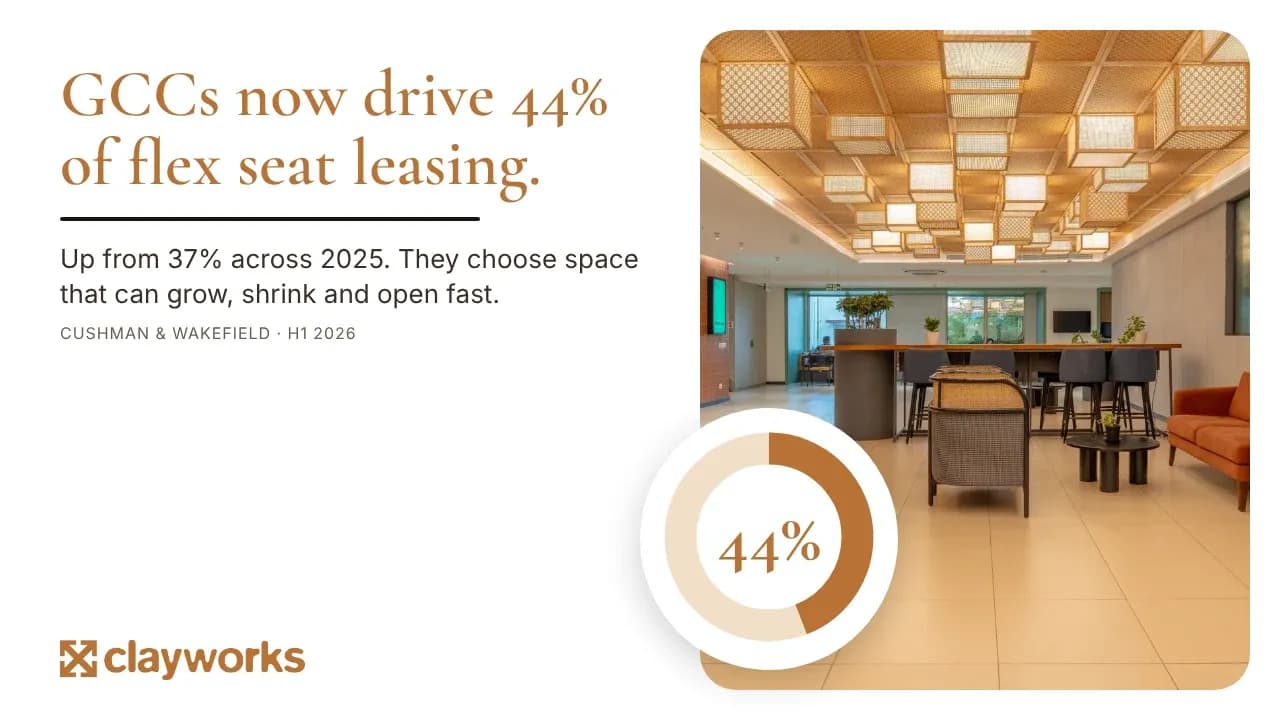
| 1. The model | How fast and how flexibly can we be working? | Flex leasing hit 12.6 million sq ft in January to September 2026, up 37% (Colliers via The Realty Today) |
| 2. The air | Can people think clearly here? | Indoor PM2.5 and CO₂ were linked to attention and processing speed across 100 buildings (Harvard Healthy Buildings) |
| 3. The light | Are people rested and comfortable? | Workers with windows slept 46 minutes more a night (PsyPost) |
| 4. The focus | Can I concentrate when I need to? | Incorrect responses fell from 49% at an open bench to 41% in a screened space (Steelcase) |
| 5. The materials | What does this room cost the planet? | Circular fit-outs could cut embodied carbon by 25–55% (Savills via NewsDrum) |
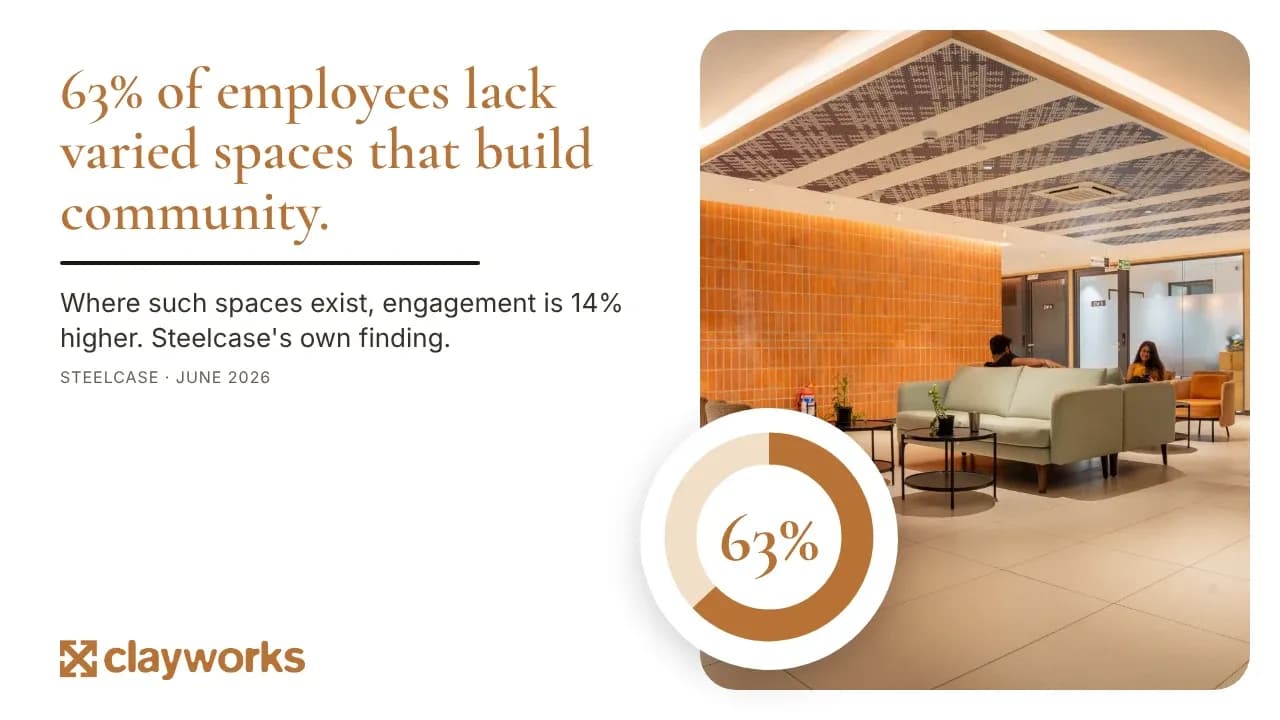
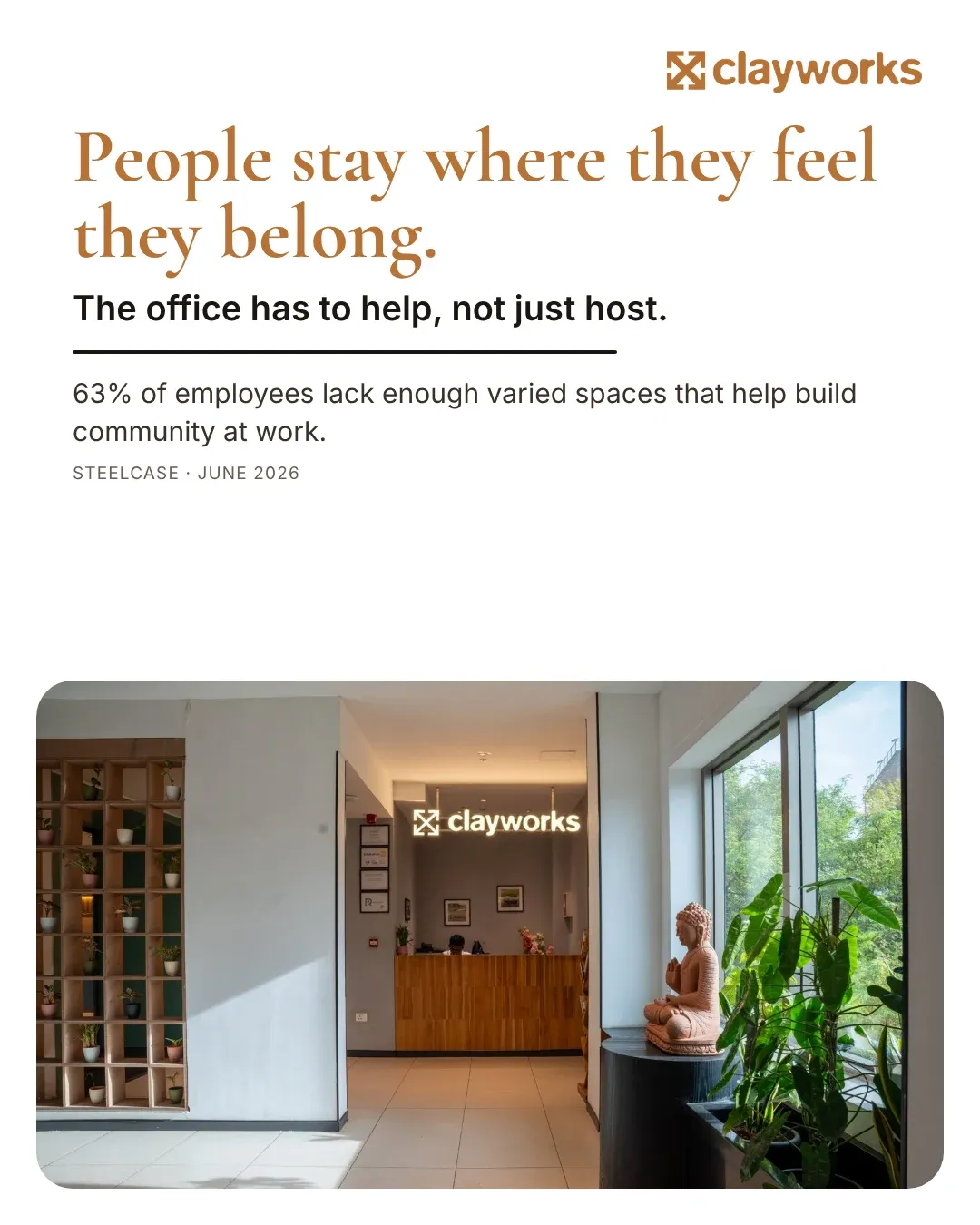
| 6. The community | Do I belong here? | 63% of employees have access to two or fewer kinds of workplace space (Steelcase) |
| 7. The care | Does anyone notice me? | Operator competition will likely turn on consistent standards across locations (The Realty Today) |
The last row is a forecast from the article's editors, not a measurement.
1. The model: managed offices, explained
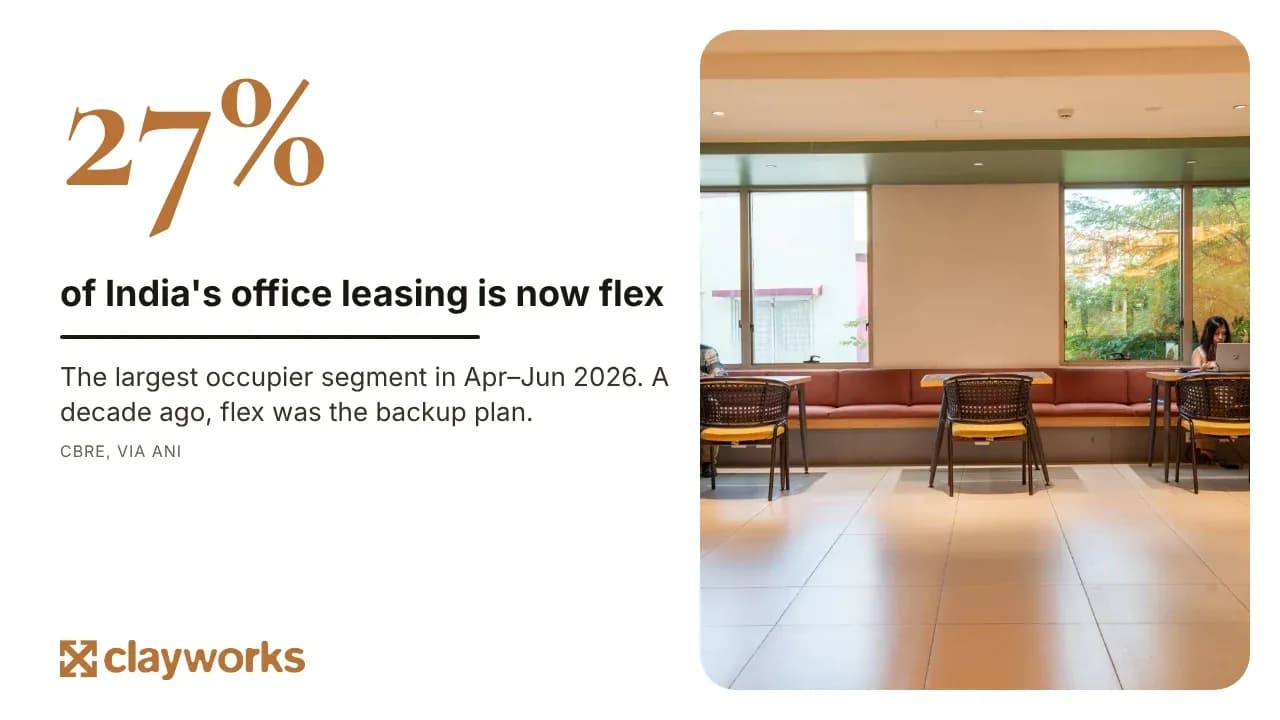
A managed office is workspace you can scale up or down, where the operator handles fit-out, facilities, technology and workplace services, often as an operating expense (The Realty Today). The market is moving that way. Colliers India recorded 12.6 million sq ft of flex leasing across the top seven markets in the first nine months of 2026, with about 4 million sq ft in the third quarter alone, up 49% on a year earlier. Bengaluru led overall leasing with 15.7 million sq ft, a 29% share. Colliers' head of research said occupiers are shifting towards managed and flexible formats, and projected that flex could rise from 15–20% of occupiers' portfolios today to 20–25% in the next few years (Colliers via The Realty Today).
One honest caution from the same coverage: flex does not automatically cost less. Compare the total cost of occupancy, including upfront capital, fit-out and management. The sensible answer for many companies is a mix, core space on a lease and flexible space around it.
2. The air nobody photographs
The quietest layer may be the most powerful. In Harvard's COGfx research, cognitive test scores in simulated office conditions were significantly better under enhanced-ventilation "Green+" conditions across all nine functional domains, and the page describes the scores as having doubled. That was a lab simulation. In a study of 100 office buildings worldwide, indoor PM2.5 and CO₂ were significantly associated with selective attention and processing speed in office workers, though the page gives no effect sizes (Harvard Healthy Buildings). You cannot photograph clean air for a brochure. You can ask how a space is ventilated and filtered.
3. The light that sets the day
Light does its work before anyone notices. In the Northwestern and Illinois study of 49 day-shift workers, those in offices with windows got 173% more white light during working hours and slept 46 minutes more a night than colleagues without windows. The sample was small and the finding is an association (PsyPost). A January 2026 experiment with 40 adults found sleepiness fell more under 1,000 lux than 500 lux, while the type of LED made no significant difference (Kim, Lee and Cho, 2026). An older eight-week trial of 94 workers found blue-enriched white light improved alertness, mood and concentration (Viola et al., 2008). Taken together, the evidence says the quality and control of light matter, not only the quantity.
4. Room to focus
Steelcase and the University of Wisconsin–Madison's Center for Healthy Minds tested almost 70 participants on an attention task, once at a shared open bench and once in a screened individual space, with typical open-office noise playing in both. Incorrect responses were 41% in the screened space against 49% at the bench. The twist is that the open bench did slightly better on a creativity test, 43% correct against 41% (Steelcase). The lesson is not to abolish open desks. It is to offer both, and to let people choose. Steelcase is a furniture maker, so treat the numbers as its own findings.
5 to 7. The layers you cannot buy off a shelf
The last three layers are the ones our earlier pieces covered in depth, and they are the ones where a space shows its character.
- Materials. The fit-out you rip out in year five costs twice. At Clayworks Opus on Richmond Road, Bengaluru, the bamboo lights come from local vendors, the 2nd floor has a rammed earth finish, and the tabletops are stone laminate and tile. We do not claim carbon figures for them, but the thinking is the one circular fit-outs ask for: local, durable and repairable.
- Community. A space needs more than one kind of place to be. Opus has open corners, meeting rooms for 6 to 25, a podcast room, a quiet prayer room and an open-air terrace with games.
- Care. A managed office is only as good as its smallest daily habits. Ours include handmade tea and staff who clear every speck of dust from a workstation before the day begins, because a clean workstation is a clean mind.
How the layers connect
The layers feed each other. Air and light decide how you feel at three in the afternoon. Focus decides what you can do with that afternoon. Materials and community decide whether you want to come back tomorrow. Care, the layer that sits behind all of them, decides whether anyone notices when something slips. An office that is strong in two layers and weak in five is not a good office with a few gaps. It is a good brochure.
Score your own office
Give each layer a mark from 1 to 5. These are practical prompts, not research findings.
- Model: Could we double or halve our space within a quarter?
- Air: Do we know how our space is ventilated and filtered?
- Light: Does daylight reach our desks, and can we control the lamps?
- Focus: Can someone work in silence without wearing headphones?
- Materials: Do we know what our fit-out is made of and what happens to it next?
- Community: Is there somewhere for a team to gather that is not a meeting room?
- Care: Would someone notice if a person went quiet for a week?
Your turn
Which layer is the weakest in your office today? Reply with its number. Founders and Claymates, we will tell you what we have learned about fixing it.
Join the conversation on LinkedIn