Why Bangalore's Neighbourhoods Matter for Your Business
Understanding Bangalore's diverse neighbourhoods can help you choose the perfect workspace location for your team. Here's our local guide.
By Clayworks Team|Aug 21, 2026
Managed Offices · Workspace Solutions · 3 min read
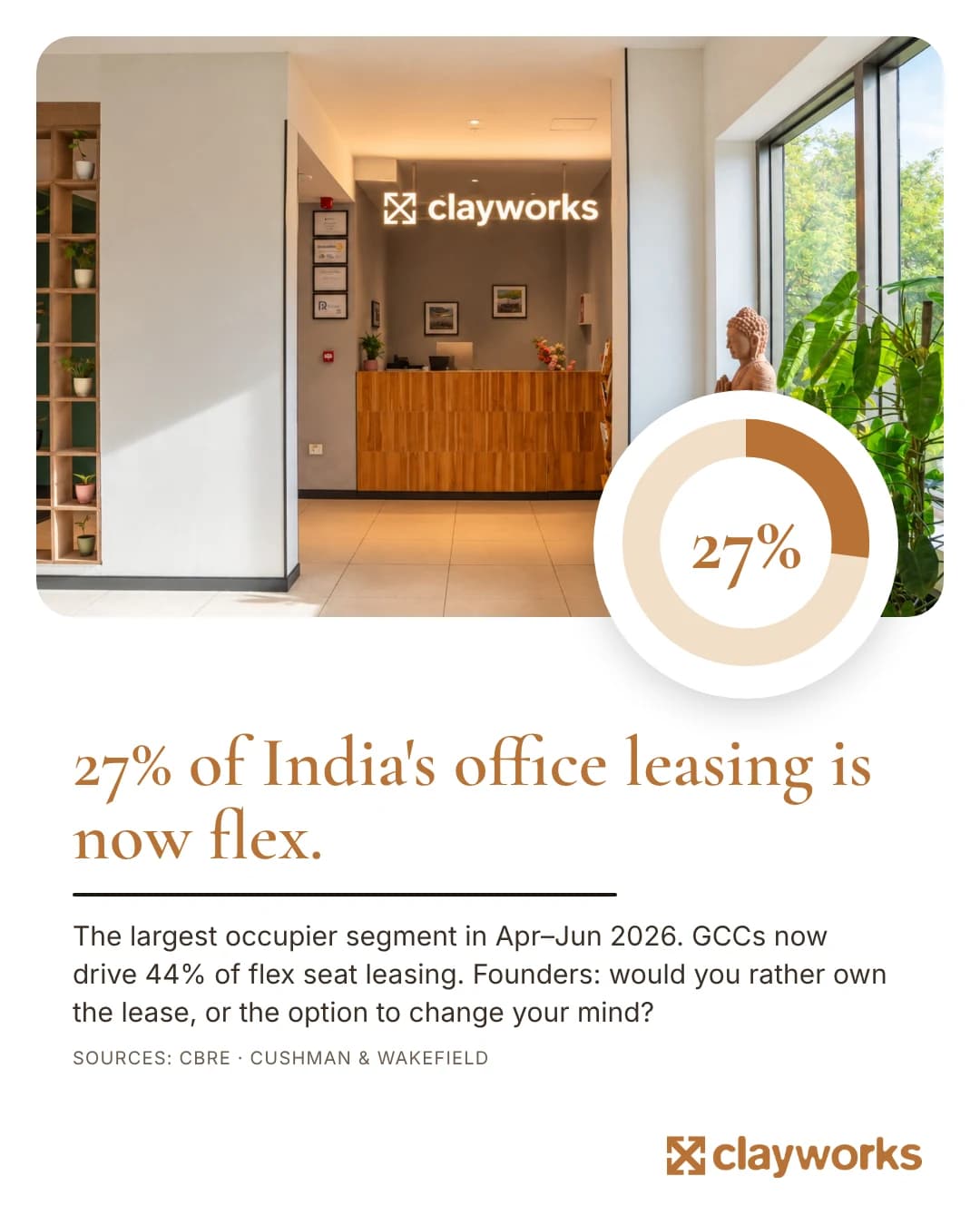
27%
That is the share of India's office leasing taken by flex operators in the April to June quarter of 2026, making them the single largest occupier segment in the market, ahead of every conventional tenant category (CBRE, via ANI). A decade ago, flex was the backup plan. In 2026, it is the plan.
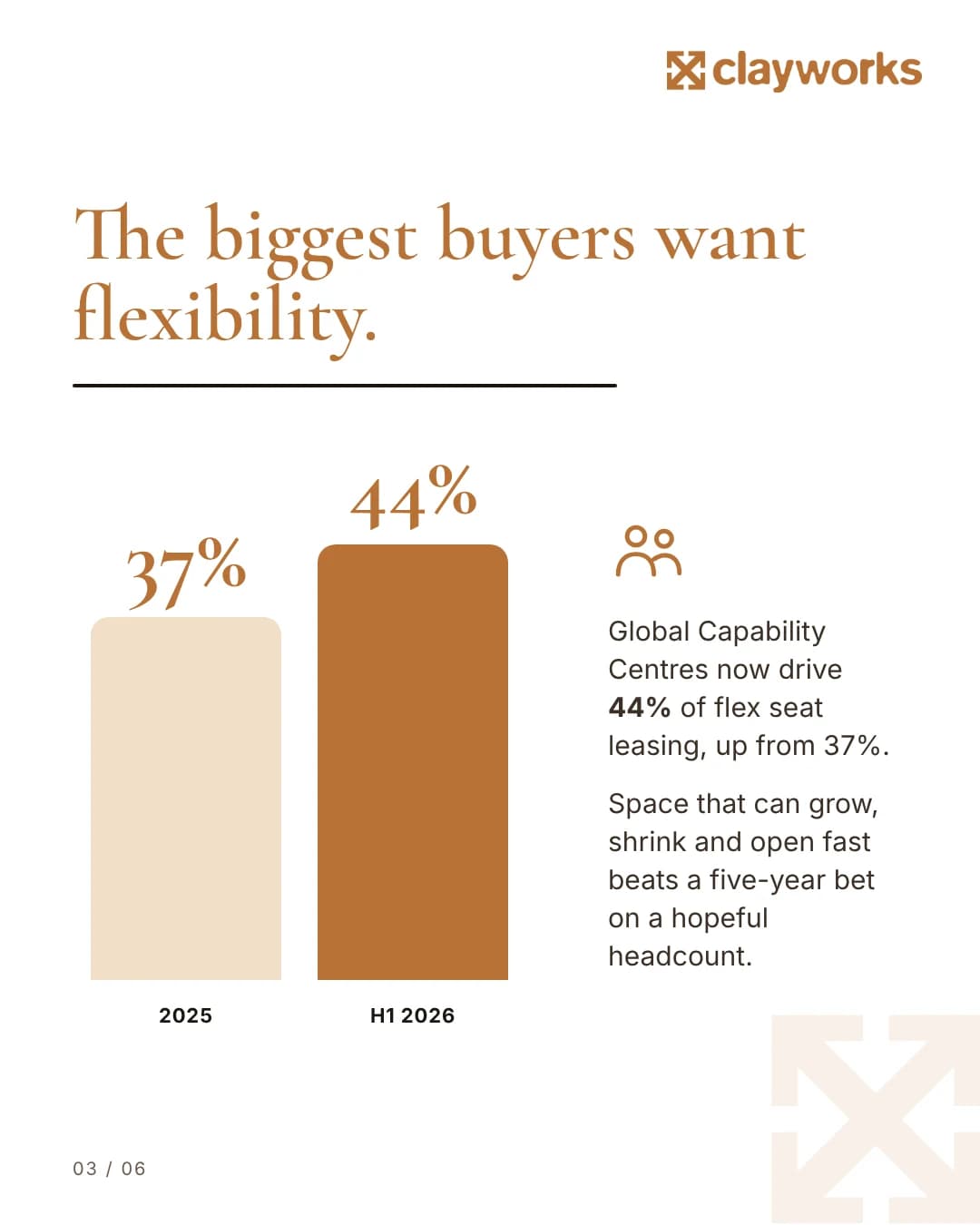
The most telling number is who is driving it. Global Capability Centres accounted for 44% of flex seat leasing in the first half of 2026, up from 37% across 2025 (Cushman & Wakefield). These are some of the most disciplined occupiers in the market, and they are choosing space that can grow, shrink and open fast. Operational agility, scalability and speed to market are the reasons the report gives.
For a founder, the lesson is plain. A five-year lease signed on a hopeful headcount plan is a bet most large companies are no longer making. They would rather pay for the option to change their mind.
Here is the quieter story. Steelcase's research with US business leaders found that about 70% of employees are expected in the office at least three days a week, a level that held across two years, and that 70% of organisations have moved or plan to move to higher-quality property (Steelcase). Note that it is a US sample, so read it as a direction, not an Indian average.
The pressure has moved from where people sit to how they think. In BCG's 2026 survey of 11,749 workers in 14 markets, 47% said they now spend more time managing and directing AI than doing the work itself, and 41% of regular AI users reported a higher cognitive load. Frontline AI use in India sat above the global average (BCG).
A team that is present but mentally overloaded is expensive. The office has to help, not just host.
Steelcase reports that 63% of employees lack access to enough varied spaces that help build community at work, and that where such spaces exist, engagement is 14% higher and productivity 8% higher (Steelcase, June 2026). Steelcase sells workplace furniture, so treat the uplift as the company's own finding. The direction, though, matches what we see on our floors: people stay where they feel they belong.
Across 20 centres and 20,000+ seats, Clayworks keeps coming back to the fifth question. A space people are proud of is rarely the cheapest option on paper, and rarely the costliest one in practice.
Clayworks Team
Oct 23, 2026
NEWSLETTER
Updates on workspace thinking, sustainability, design ideas, and event invites. Zero spam, just relevance.